(The history, emergence, and development of writing)
The writing system and its historical development arose from the growth of human cognition, changing needs and demands, and the consequences of human communication across different eras. It developed through a complex linguistic process because human beings wanted writing to remain and endure.
Across the 400,000-year development of the cultural revolution and the 40,000-year development of human language, the forms and stages of writing moved from ordinary needs toward the sensitive objective of preserving writing, events, and stories. Writing enabled powerful communication and opened a channel through which the earliest human beings could address later generations. Within this complex process of preservation, the invention of writing constituted an explosion and a distinctive development.
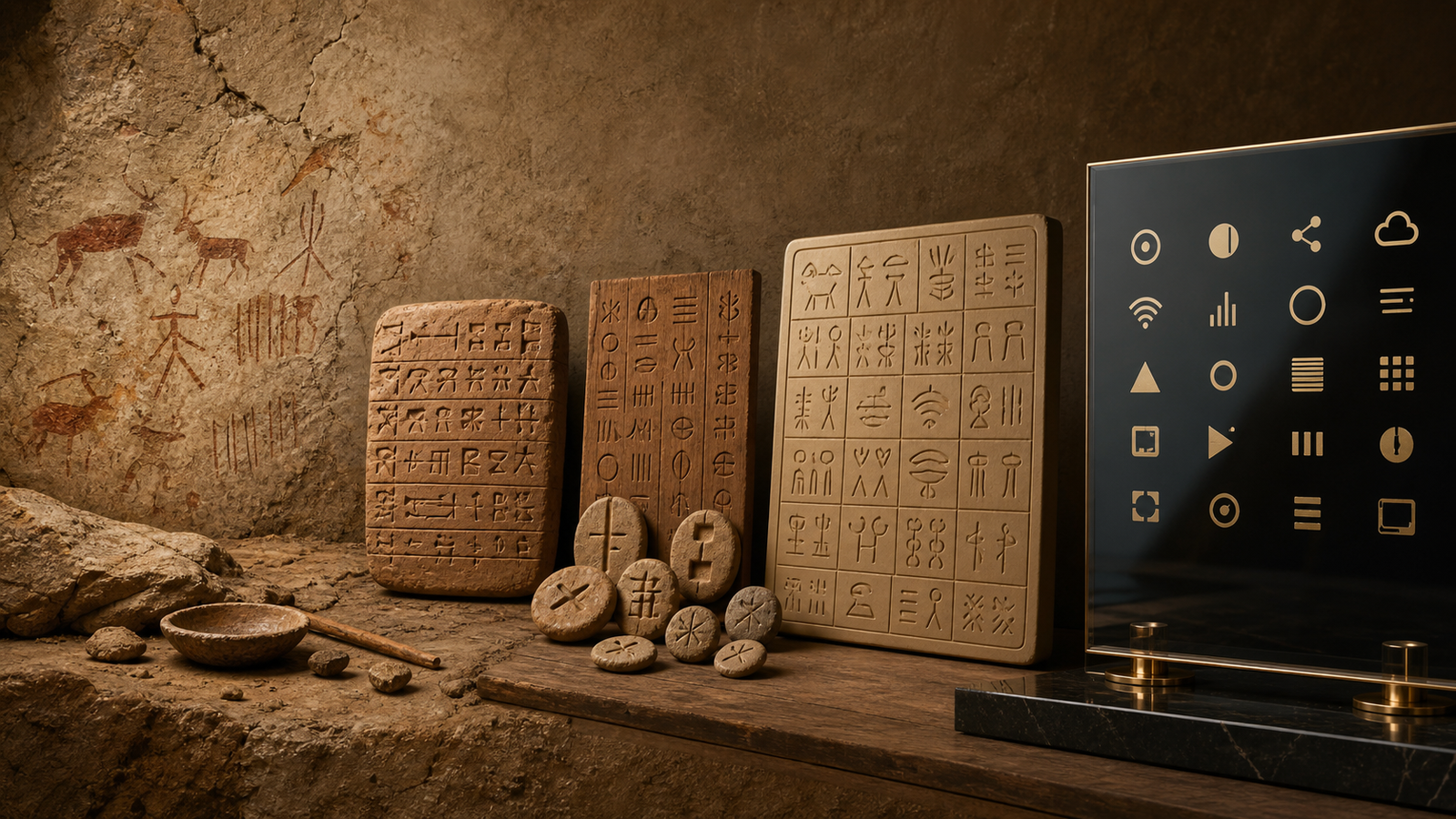
From ancient times, humans used pictorial signs, or pictograms1. In this kind of writing, each word corresponds to an image or sign. It is encountered especially in caves, where a symbol carved or drawn on a wall or stone represented a word. This writing lacked the linguistic power and depth of modern language and writing. Yet pictorial and word-based signs have not disappeared from modern humanity; they remain highly active in cities, beyond cities, and in public spaces as boards, symbols, warnings, and cautionary images.
The next form was word-sign writing, or the logogram2. Here certain signs and symbols conventionally functioned as independent representations of an object, instrument, living being, or event. A sign for an object or instrument referred to its concept in an encoded, hidden manner, to be read symbolically and cryptically. Ideographic writing3 then appeared. In this form, the meaning and purpose of an object or instrument were specified. Each sign conveyed a particular concept, a semantic value, or several meanings. A carved or drawn ear of wheat, for example, represented the strength and status of wheat, agriculture, food, and the sacredness of wheat.
From these three historical trajectories of writing emerged one of humanity’s greatest inventions, the foundation of subsequent discoveries, modernity, and civilisation. Another important form with distinctive encoded qualities was rebus writing4. In this method, an image or sign represented a sound or phoneme. A sign carried the phonetic weight of a language; encountering it allowed a reader to identify a sound, and combining signs produced the code for a word. To describe a mountainous region, for example, signs coding sounds associated with “tree,” “leaf,” and “mountain” could be combined like a modern compound word, leaving future generations an encoded sign for “forest.”
Another highly distinctive form that established itself in languages was syllabic writing5. Here a sign represented a syllable composed of a consonant and a vowel. Each sign in a language corresponded to one of its syllables. Very few languages retain this kind of system; Japanese uses a version in which particular signs carry spoken syllables6, each sign representing one of the language’s monosyllables7.
Using pictorial signs in caves, humans left secrets and concealed information for travellers, migrants, and later generations. They might carve a mill on a cave wall to represent a miller, or draw a key to represent a guide or leader.
They also depicted a wild or domesticated animal, or trees and vegetation. These were the concepts, movements, and coded vocabulary of this major human achievement across the 400,000-year cultural revolution of developed humanity, enabling it gradually to bring the entire Earth under its influence.
Writing possessed this extraordinary and almost magical power during the 40,000-year linguistic development of humanity. Its newest and most advanced forms continue along the same developmental path. The earliest principles of writing moved from caves toward technology. Modern infographics8 perform the same function as the pictorial symbols used in caves 400,000 years ago: modern people express intentions and requests through emoji and stickers, continuing the same foundational data and writing system.
Written by Sabir Zhakaw
Sources:
Sabir Zhakaw, Avashin Etymological Dictionary, unpublished.
Sabir Zhakaw, A Linguistic Inquiry 1 and 2.
Sabir Zhakaw, “The Emergence of Writing by Human Beings,” Ziman u Zar journal.
Sabir Zhakaw, “Language and Speech,” Ziman u Zar journal.
Thanks and appreciation to the Pernus Cultural Centre and the Kurdipedia website for their efforts in extending the article’s publication.
Pernus website:
https://pernus.org/show/141/detail
Kurdipedia website:
https://www.kurdipedia.org/default.aspx?q=20230401231210478918&lng=1#
Linguistics Telegram channel:
@zimannasi
زارگە · گفتوگۆ
لێدوانەکان٠
٠ لێدوان · ٠ وەڵام
دەسەڵاتەکانی لێدوانەکانت پشکنراون…
هێشتا لێدوان نییە — یەکەم کەس بە کە بۆچوونەکەت بنووسیت.