☼ Heterê — Meterê ☼
In these days, following a historical tradition connected with the renewal of nature and with humanity’s historical thought concerning natural and environmental phenomena and contemporary mythologies, Kurds, like most peoples of the world, practise traditions of environmental and natural renewal in several forms. One of these is Newroz, with its complete set of ceremonies and forms.
Of importance here are two profoundly ancient expressions from extinct, semi-active, and inactive languages whose traces survive in Kurdish as constituent elements: Heterê and Meterê.
Kurdish has naturally preserved and continues to use these two metaphors and idioms, without abandoning them even in the present era. They are historically deep and ancient expressions deriving from heter and metere.
First, consider the word’s present active form in Kurdish:
Heterê Meterê, place something for us beneath the fence;
or: Heterê Meterê, throw something for us beneath the fence;
or: Heterê Meterê, it is Newroz, come outside; our Newroz gift is outside;
or: Heterê and Meterê, my horse’s head at the donkey’s rump; throw something for me before the fence.
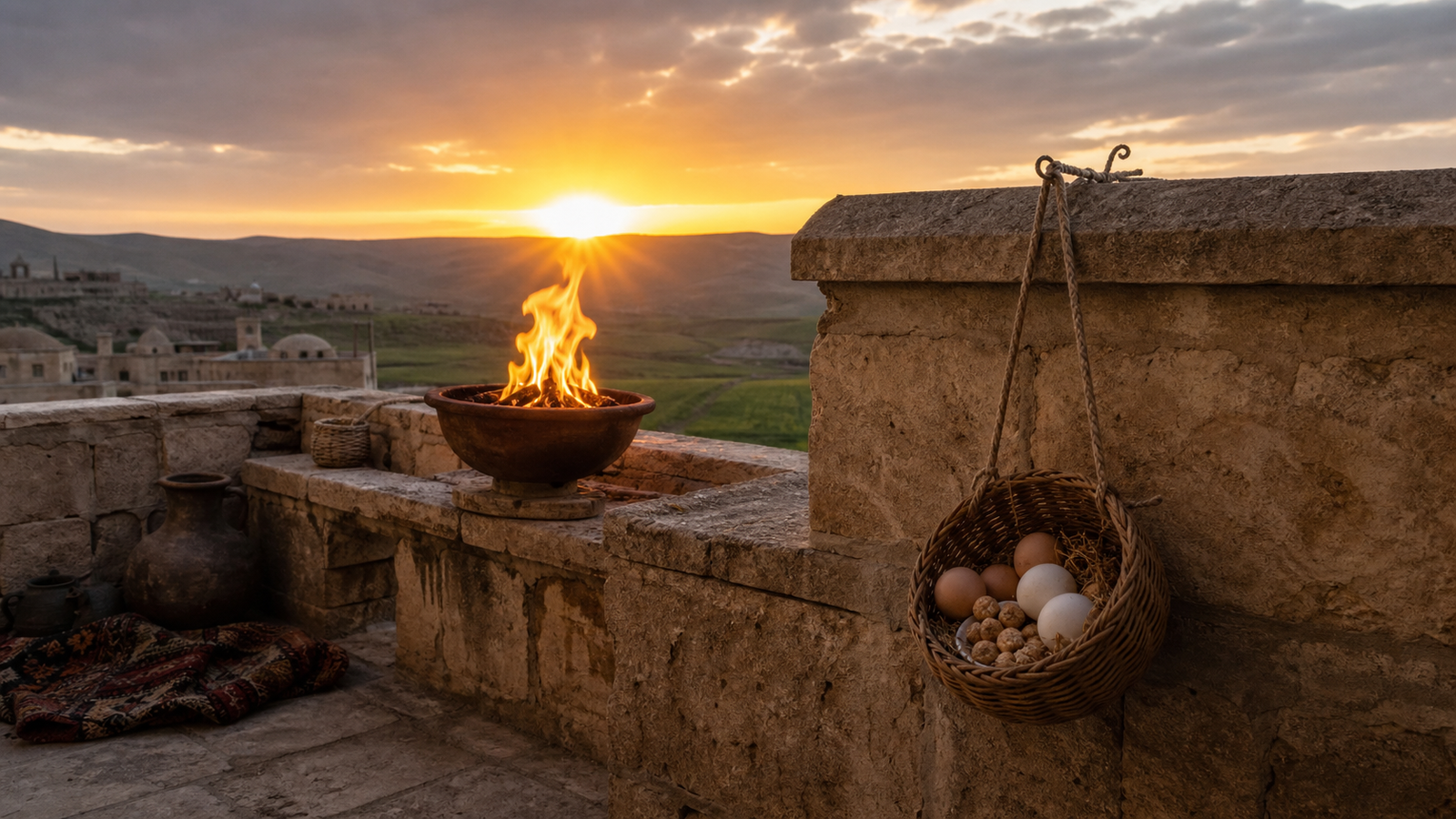
This request and refrain was recited by young people and children as they walked through villages, towns, and alleys and approached the doors of homes. From an opening in the roof they lowered a basket, hamper, or other container, and householders placed sweets, sugared nuts, eggs, and similar festival gifts in it before they continued to the next house.
This is the form and type of the ceremony as it has survived. What is striking is that its history has not been severed from the thought of the earliest human beings, whose development of culture, art, civilisation, and, to some extent, language over more than 400,000 years moved toward shared mythologies and natural phenomena. Human ceremonies across history and the world are shared and remarkably close to one another; they are simply diverse developments of the same patterns. The present ceremony among Kurds and neighbouring peoples is a development of these rituals.
One aspect that draws the subject toward itself is the position of “woman” as “mother, creator of being, and giver of feeling” in ancient Kurdish mythology and during the ascendancy of the Mithraic religious mythology, where the woman’s position as a source of feeling was elevated. Woman was not merely mistress of the household but keeper of its hearth at a time when the dominant religious mythology viewed the sun as the mother-deity of fire. We therefore consider the word Mithra within the ancient mythology of this ceremony and compare it, metrically and etymologically, with meter.
The word meter has weakened so greatly in modern Kurdish that it has been abandoned, although it remains lexically highly active in Indo-European and Iranian languages. Its root first appears in Proto-Indo-European méh₂tēr, meaning “mother”; it is active in the Iranian languages as máHtā and in Indo-Aryan as máHtā and mātr. New Persian uses mɑːdar. Kurdish employs different lexical developments in ma, mama, make, mê, mêyine, but has let go of the powerful historical word itself. Without pursuing the lexicon of the root further, we note only its historical origin. The historical phonological assimilation from Proto-Indo-European mêhtêr involved vowel substitution and the softening of /ê/ to /î/, moving from mêhêtir toward mihitir. Another name of Mithra accordingly appears as Mihtira.
The second important expression is hetere. In both Kurdish expressions, the morphophonemic function of ê carries a lexicological and morphological role as a derivational suffix of declaration and identification. The word developed from Proto-Iranian HáHtr̥ʃ, Proto-Indo-European h₂ehʊɾa, and Indo-Aryan atheɾ. In Avestan it actively appears as atar, atara, atr, athr. The word spread widely through this language family. Its historical trace and code survive only in the children’s request and repetition of these two historical words in Kurdish; among no other language or people of the region do we encounter this form preserved with equal vitality and activity.
At the sentential and declarative levels, Heterê and Meterê together mean “mother’s fire.” This is among the traces and evidence of the ritual and its history among Kurds and neighbouring peoples under the religion and mythology of Mithra. The word Mithra itself is a development of the same word metere. This historical request and supplication addressed the mother-deity, the sun, asking the deity and possessor represented by heter and meter: at once fire and mother. It accompanied the renewal, rekindling, and intensification of the sun, the deity and mother of warmth, during the days when the environment and nature renew themselves. Their request and prayer were directed toward “the mother’s fire.”
Principal source:
Avashin Etymological Dictionary.
#SabirZhakaw
Note: republication of this article without the author’s name is not permitted.
زارگە · گفتوگۆ
لێدوانەکان٠
٠ لێدوان · ٠ وەڵام
دەسەڵاتەکانی لێدوانەکانت پشکنراون…
هێشتا لێدوان نییە — یەکەم کەس بە کە بۆچوونەکەت بنووسیت.