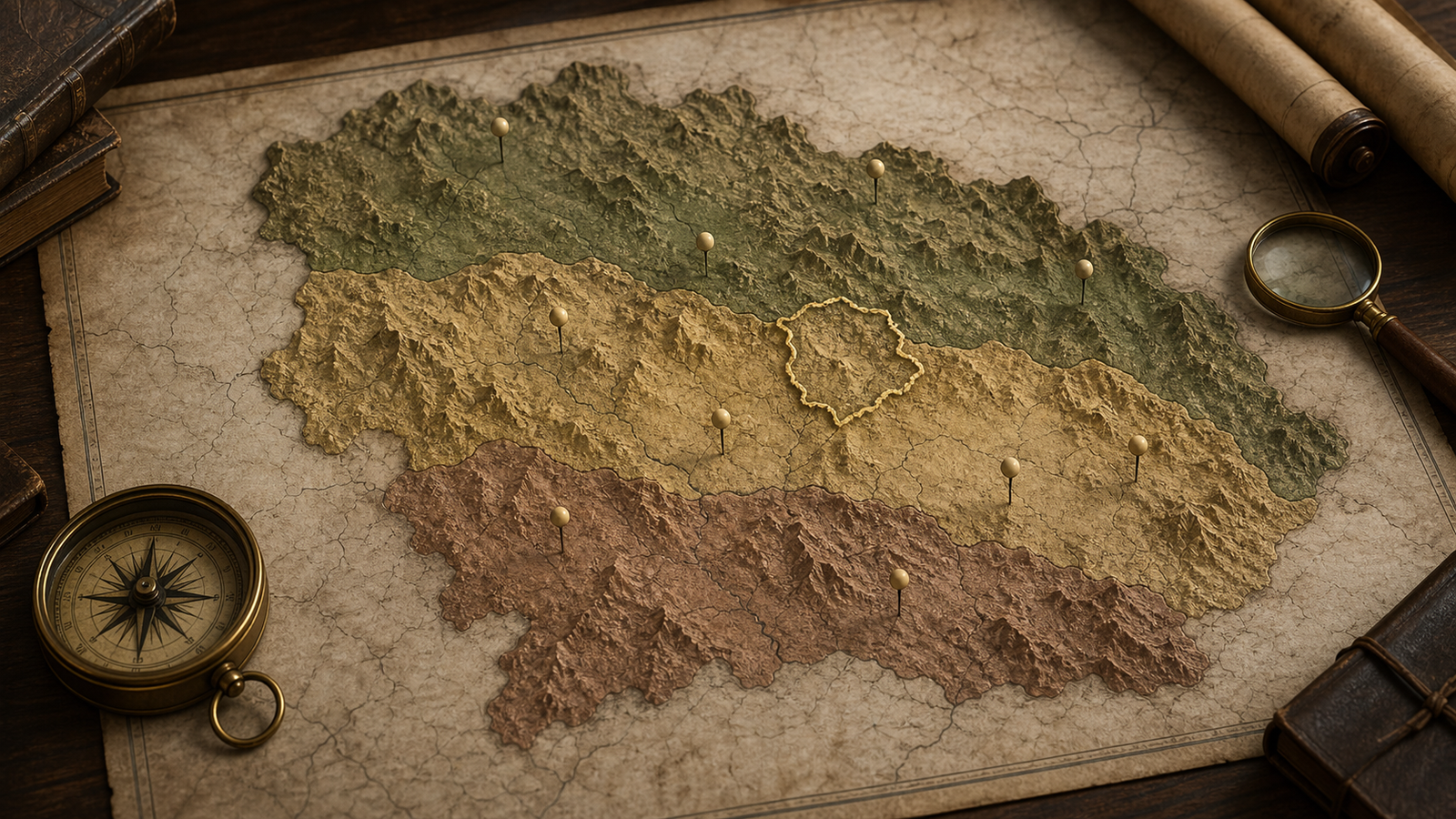
An important issue concerning the naming of Kurdish dialect families is the powerful influence of tribalism. Within this sphere, a name such as “Sorani,” originally the name of a region, place, and tribe, came to be used in scientific linguistics for a Kurdish “language zone,” specifically the Central zone. According to the current scientific and logical classification of Kurdish, the Kurdish language tree is divided into three active linguistic zones: Northern, Central, and Southern. The name Sorani is used only in place of the Central zone, although it is fundamentally baseless and unscientific. In the world’s extinct and living languages, sociolinguistics confronts many cases in which, for geopolitical reasons, the name of a language derives from a tribe, people, or region. This historical and linguistic tendency has not been interrupted in Kurdish.
To begin, let us briefly return to the history of the name, where the family and region were situated, and who they were. Sorani was a powerful principality in the Rawanduz region during the period of Mir Muhammad the Great, known as “the blind king,” who ruled the Sorani principality. This ruler emerged while two powerful poles dominated Kurdistan, the Ottoman and Iranian spheres. He sought to establish a strong and active power. Pursuing this ambition, he expanded his army to nearly fifty thousand fighters and attacked other Kurdish principalities, including Amedi, Zakho, Akre, Koya, Ranya, Erbil, Cizre, and Mardin. The strongest and best known of these rulers was the prince of Amedi. These principalities differed greatly in both the field geography of Kurdistan and linguistic geography. During Mir Muhammad the Great’s campaigns to collect taxes and levies and obtain iron for cannon production in his cannon works, he entered the territory of the former Bahdinan principality, whose capital was Amedi. After other victories and campaigns, he captured this powerful principality and took control of it. Following the attack and seizure, the people of regions such as Amedi came under the hegemony of the Sorani ruler. Their environmental and spoken language differed, but where it resembled the language of Sorani, especially the Rawanduz variety, anyone heard speaking that environmental language after the conquest was quickly labelled with the principality’s and tribe’s name: “this person is Sorani.” This pattern has recurred repeatedly in history. Many languages were named in this manner simply by identifying people through the language they spoke, even where the person’s language and country had different names. The practice persists even among people at advanced stages of civilisation: within individual sociolinguistics, language becomes a measure for identifying ethnicity. This gradually caused the name to take on an influential linguistic role in Kurdish. The natural foundations of the regions under Sorani political hegemony, later reinforced by political actors and conditions, made the geopolitical process more active and influential, allowing the name to emerge as the name of a dialect zone. Yet speakers within this linguistic area only rarely identify themselves as Sorani. Jaf speakers identify as Jaf, Ardalan as Ardalan, Garmiyan as Garmiyan, and Sulaymani as Sulaymani. Very few individuals connect or identify themselves as Sorani. The linguistic designation emerged with the development of Kurdish language science and linguistics over approximately the past eighty years. Regions belonging to the Central Kurdish zone were presented as “Sorani” in books, pamphlets, and linguistic studies. Later writers followed and imitated earlier works, continuing to use Sorani. Consequently, even inhabitants of areas geographically and linguistically distant from the Sorani region continue to apply the name Sorani when discussing the language.
Sources:
• Sabir Zhakaw, Language, an Element of Being, 2022, forthcoming.
• Kamal Mazhar Ahmad, Baban, Soran, Botan, Baghdad, 1985.
Written by Sabir Zhakaw
Telegram: zimannasi@
Article reproduced from the Pernus website:
زارگە · گفتوگۆ
لێدوانەکان٠
٠ لێدوان · ٠ وەڵام
دەسەڵاتەکانی لێدوانەکانت پشکنراون…
هێشتا لێدوان نییە — یەکەم کەس بە کە بۆچوونەکەت بنووسیت.