
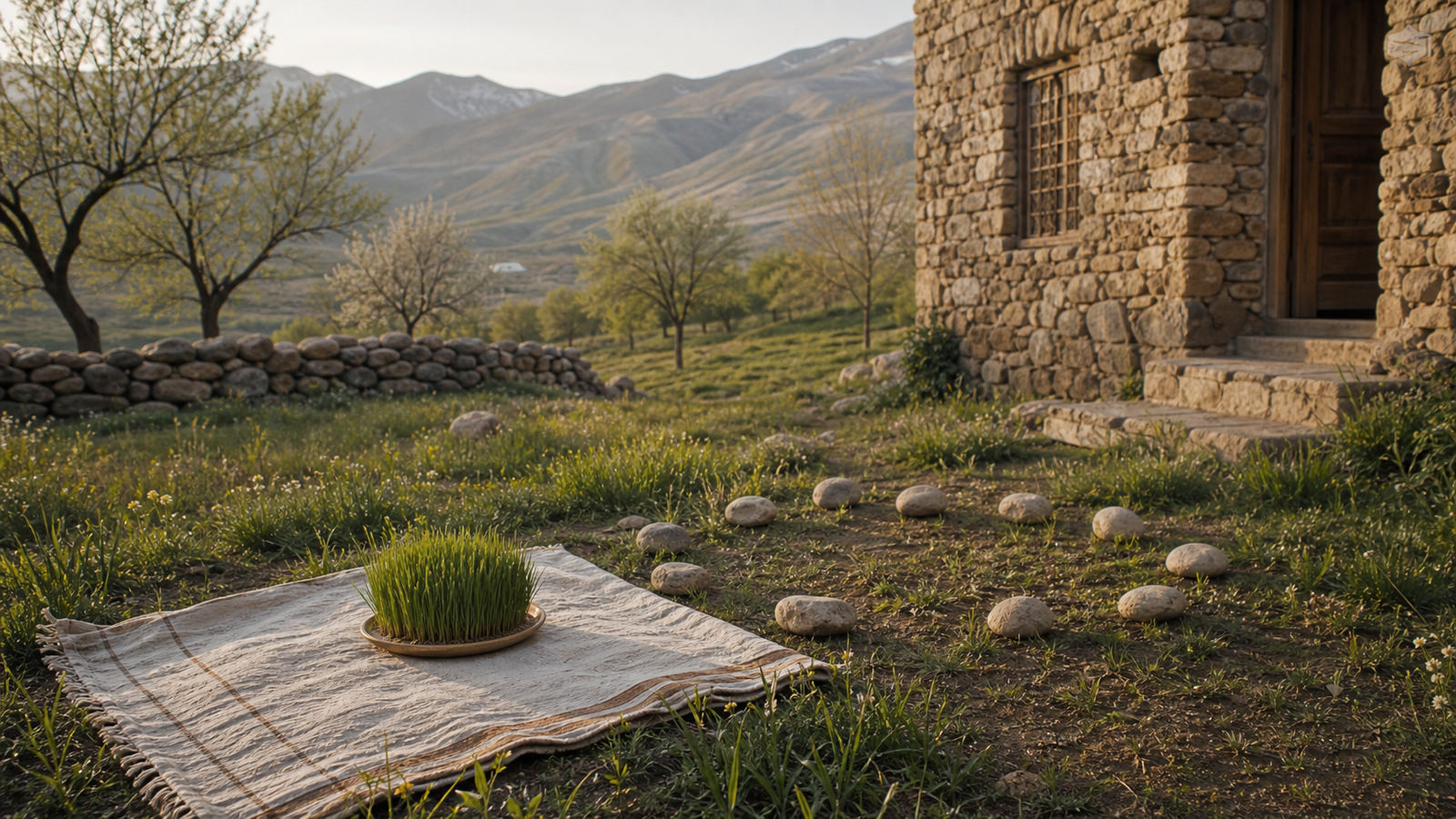
Sizdah Bedar
Many accounts, writings, and references to this occasion have circulated here and there, but they are more often nationalist and mythological than logical and etymological.
Many people relate this day and observance to archaeological and theological matters and connect it with a variety of subjects.
From a theological and religious perspective, one account holds that in Zoroastrian belief God completed the creation of the Earth over 365 days, ceased work and rested on the first day of Newroz and Xakelêwe, and brought the process to an end. On the first day of Xakelêwe, the fravahar returns to Earth. In Mazdayasnian oral literature, the return of the fravahar is recounted in a distinctive myth. The fravahar, or fravashi, is one of the sacred energies of the human being, accompanying a person before creation and remaining with them in purity until thirteen days after death.
Zoroastrians also believed the Earth’s lifespan to be thirteen thousand years. This interpretation was adopted under the influence of neighbouring Mesopotamian peoples. In their belief, each of the twelve zodiacal constellations governs the world for one thousand years. Together, the twelve signs rule the Earth for twelve thousand years, after which the world ends. This belief belonged particularly to the Babylonians, who influenced them.
ـ Another view holds that on the thirteenth day of Xakelêwe, during the reign of the Achaemenid Xerxes, a major massacre of Iranians occurred. Thereafter, Iranians treated the number and the day as inauspicious and impure.
ـ In Christianity, which actively contributed to spreading the number’s inauspicious reputation, Jesus’s closest companions, the apostles, numbered twelve with Jesus himself. When they became thirteen people, Jesus encountered suffering and calamity and was crucified.
ـ Some relate the day to Babylonian and Sumerian customs and ceremonies. The Sumerian New Year, called Zagmuk, and the Babylonian Akitu lasted twelve days. After those twelve days, people remained outdoors within nature and the environment. This observance is approximately 5,500 years old.
Much has been written about why the day was named Sizdah Bedar, although most explanations may be neither scientific nor logical, or at least may lack scientific and logical evidence. What is clear is that Sizdah Bedar is a compound of the number sêzde, sênezde, sênze (“thirteen”) and be der hatin, meaning to leave the house: be der/we der + kewtin. It also denotes expelling the number thirteen.
According to the observance, people spend twelve fortunate and joyful days at home and go outside on the thirteenth for an excursion into nature; alternatively, they empty and clean the house, expelling grief, calamity, trouble, impurity, and discord from themselves and their homes.
The concept of thirteen has been widely introduced into the cultures of other peoples through Christianity.
Many accounts describe thirteen as an inauspicious, unsuitable, impure, and ill-omened number. The thirteenth day, which follows the twelfth, is therefore viewed as something to be expelled, and on that evening people cast out their “thirteen.”
In countries under Christian religious influence, Sunday is a day of rest and withdrawal from worldly work. People are expected to rest, devote time to God, pray, bow, and repent. This idea runs counter to Islamist ideology, which treats itself and its God as superior and acceptable above all others; for this reason, it has attacked and conquered other beliefs and cultures.
The denigration of the number thirteen and its depiction as impure and inauspicious do not, in the author’s view, acquire logical force through any of the explanations offered by Islamists.
Within the Aramaic alphabet is a system known as Abjad.
Each letter in this alphabet has its own numerical code. The Christian Sunday, according to the Aramaic Abjad alphabet, becomes:
(أ: 1), (ح: 8), (د: 4), forming (أحد). But what is the connection?
The sum of 1, 8, and 4 is 13. In the Aramaic Abjad alphabet, Sunday is aḥad, and Aḥad is also one of the Islamic names of Allah.
After the Crusades and the ascendancy of Islamic powers, this idea spread widely into Christian culture and custom. For Muslims, the day and occasion stood against Allah and their religion; only Friday was to be a day for God, because in their sacred book only that day is holy.
#SabirZhakaw
http://rishanasi.blogfa.com/post/21
Linguistics Telegram channel:
@zimannasi
زارگە · گفتوگۆ
لێدوانەکان٠
٠ لێدوان · ٠ وەڵام
دەسەڵاتەکانی لێدوانەکانت پشکنراون…
هێشتا لێدوان نییە — یەکەم کەس بە کە بۆچوونەکەت بنووسیت.